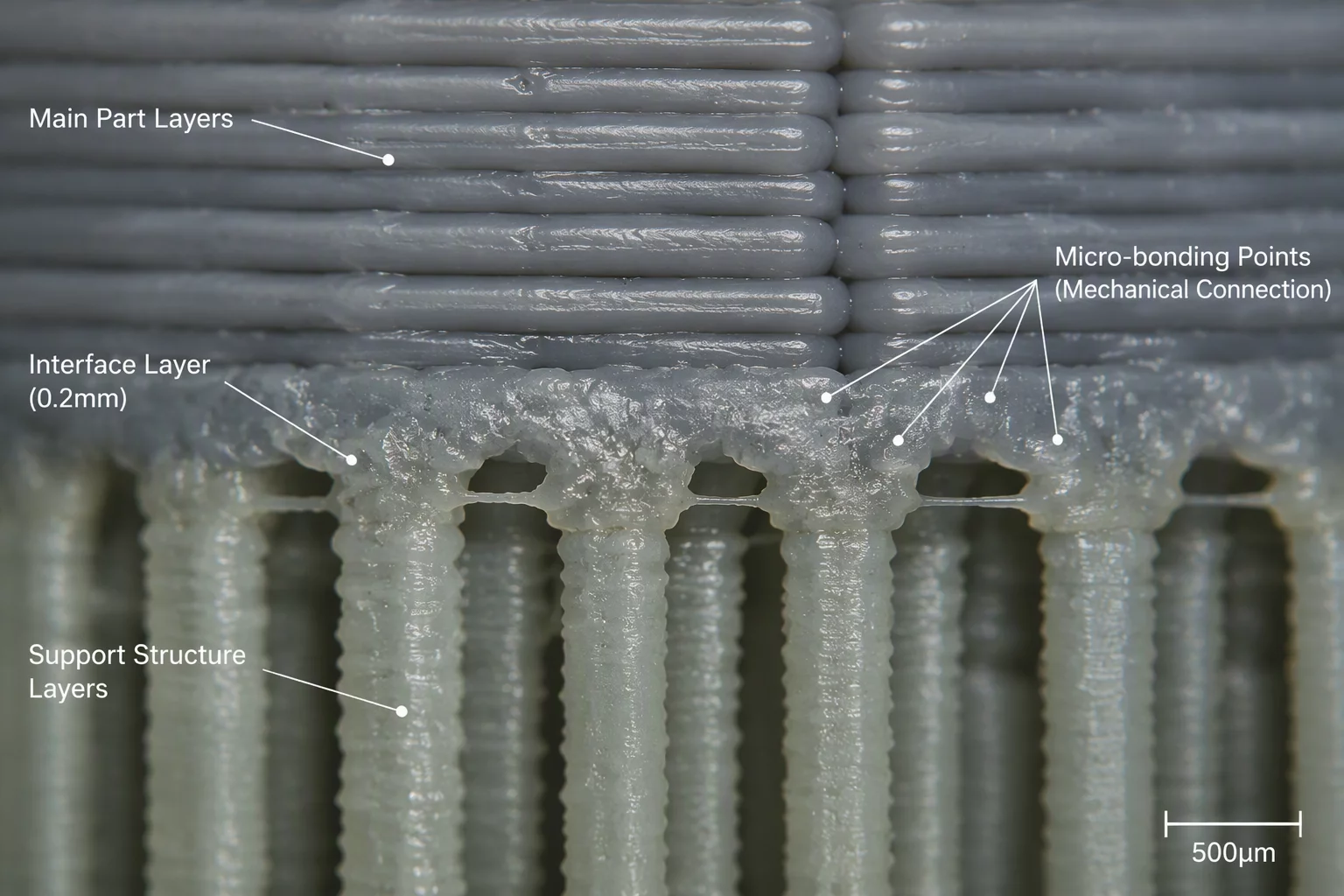
The Fundamental Tension at the Interface Boundary
Additive manufacturing engineers constantly grapple with an unyielding mechanical paradox during fused filament fabrication. The primary function of a sacrificial interface demands adequate structural adhesion to resist nozzle drag, dynamic acceleration vibrations, and the downward gravitational pull of molten polymer strands. An interface that bonds too tenaciously transforms support separation into a destructive manual extraction, tearing surface laminations and permanently gouging structural skin layers.
The boundary between temporary scaffold and permanent geometry acts as a semi-welded joint governed by thermal fusion kinetics. As extruded beads contact the cooled interface grid, molecular chains diffuse across the boundary layer. The depth of this macromolecular reptation determines the ultimate peel force. When interfacial contact approaches full solid density without a calibrated thermal offset, the chemical bond strength mirrors intra-layer adhesion, eliminating the mechanical release plane entirely.
Mechanical Adhesion Mechanics and Contact Fraction
Laboratory shear testing demonstrates that the physical ease of support detachment depends directly on the effective interfacial contact fraction rather than nominal support volume alone. Modulating spacing between adjacent interface extrusions alters the micro-stress concentrations during mechanical cleavage. A tightly packed raster distributes nozzle pressure uniformly, yet creates a continuous fusion film that resists wedge propagation.
- Interface contact ratios exceeding 85% generate unbroken thermal weld lines, elevating necessary stripping force beyond the inter-laminar shear limits of standard polyester compounds.
- A vertical Z-distance maintained at precisely one full layer height permits localized plastic sagging into micro-crevices without forming homogenous molecular cross-linking.
- Dynamic toolhead acceleration over interface perimeters creates intermittent bead tension, providing natural micro-voids that initiate micro-fractures during initial manual peeling.
- Thermal gradient mismatches between high-flow cooling fans and interface contact layers accelerate crystalline boundary formation, weakening joint toughness without destabilizing horizontal bridge spans.
Practical Calibration for Zero-Damage Support Release
Achieving predictable separation requires treating interface parameters as an independent rheological domain. Slicing engines typically default to uniform volumetric flow across both the model boundary and support skin. Operators can bypass surface scarring by programming an intentional 8% flow under-extrusion exclusively into the interface top layer, producing a deliberately underfilled contact plane that shears cleanly under mild torsional leverage.
Applying distinct raster orientations between the interface ceiling and the initial supported floor layer prevents matching filament tracks from settling into parallel troughs. Aligning the interface ceiling at 45 degrees relative to the supported overhang forces the molten part filament to bridge microscopic ridges rather than melting into matching grooves. This geometrical mismatch restricts contact points to tangential tangents, cutting ultimate peel force by more than half while preserving surface planarity.
Discussion & Peer Findings
0 RemarksNo comments yet. This could be your first comment.
Leave Laboratory Observation