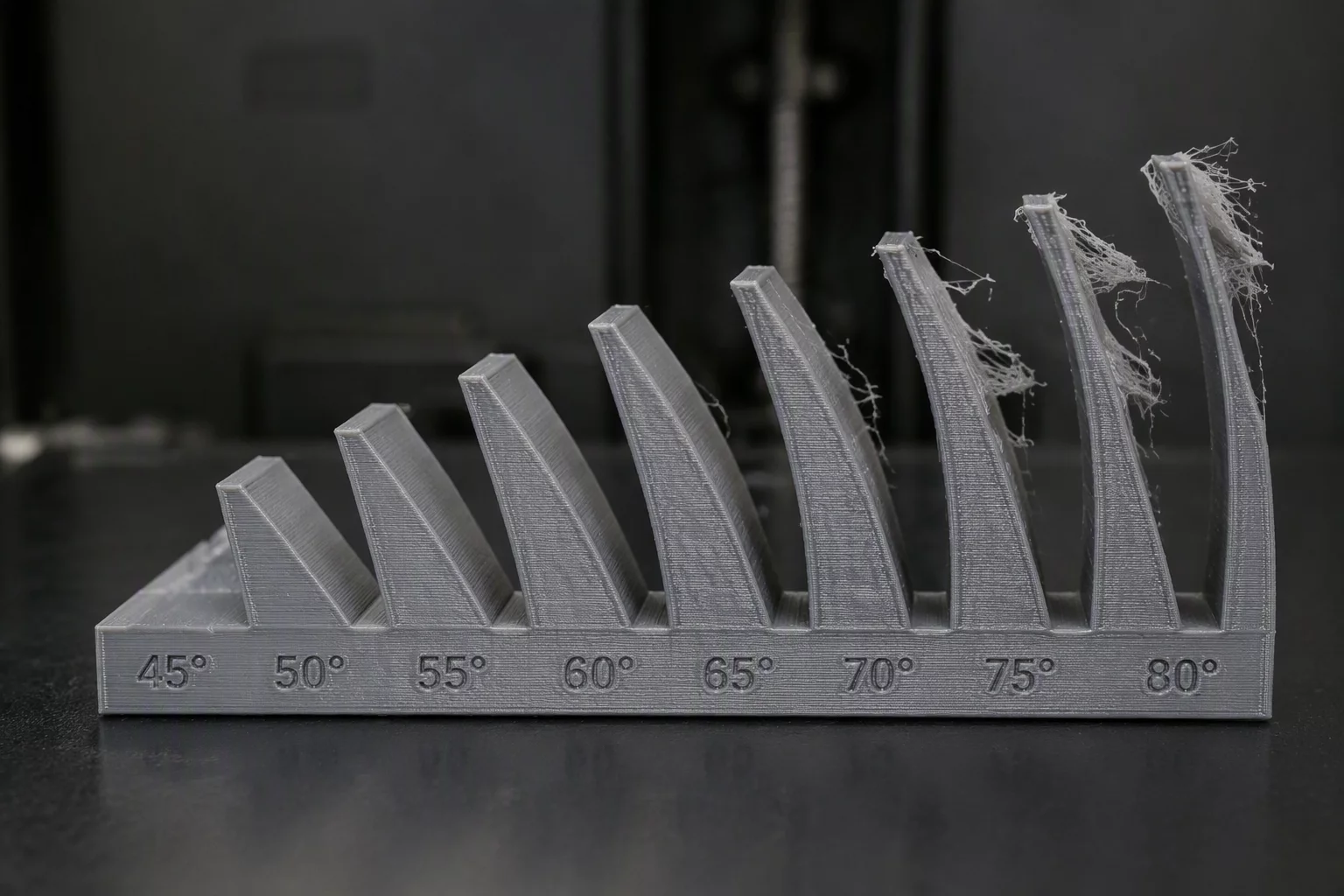
Mechanics of Molten Polymer Cantilever Deposition
When a 3D printer extrudes thermoplastic across an unsupported boundary, every successive strand acts as a microscopic viscoelastic cantilever. In standard Cartesian toolpaths, each layer rests on the solid footprint of the layer beneath it. Once the overhang angle exceeds 45 degrees, the outer bead loses more than half of its supporting contact area, shifting mechanical stability toward surface tension, viscous shear resistance, and rapid cooling.
Without adequate convective thermal management, molten strands remain pliable above their glass transition temperature. Gravity pulls the unbonded section downward before crystal nucleation or polymer chain entanglement can lock the bead into place. This displacement introduces cumulative geometric drift, resulting in curling edges, rough interfacial ridges, and localized delamination across exterior perimeters.
Critical Thresholds and Cantilever Forces
Experimental measurements demonstrate that molten bead stability depends on three coupled physical variables: line width-to-height ratio, extrusion velocity, and directional cooling airflow. Below a 45-degree inclination, cohesive forces between adjacent tracks prevent perceptible sagging. As the overhang approaches 60 to 75 degrees, internal shear stress overcomes thermal stabilization:
- High line width-to-layer height ratios provide a broader mechanical landing zone, increasing the contact boundary for subsequent layers.
- Directed auxiliary cooling accelerates vitrification, minimizing the gravitational settling window from 350 milliseconds to under 80 milliseconds.
- Outer perimeter deceleration reduces dynamic nozzle drag, preventing the still-soft bead from stretching or tearing away from anchor coordinates.
Structural Implications for Slicing Strategies
Optimizing slicer algorithms requires balancing deposition speed against cooling capacity. When slicing steep chamfers or dome geometries, setting dynamic overhang speed profiles preserves dimensional integrity without unnecessarily inflating overall print times. Slicers must evaluate local surface normals and automatically adapt flow rates to maintain consistent bead volume across unsupported vectors.
Understanding these thermal dynamics allows engineers to design self-supporting geometries while reserving dense support interfaces only for extreme angles exceeding 70 degrees. This targeted approach reduces post-processing cleanup and prevents aggressive interface tearing on aesthetic surfaces.
Discussion & Peer Findings
0 RemarksNo laboratory observations posted yet. Be the first to submit peer findings for this paper.
Leave Laboratory Observation