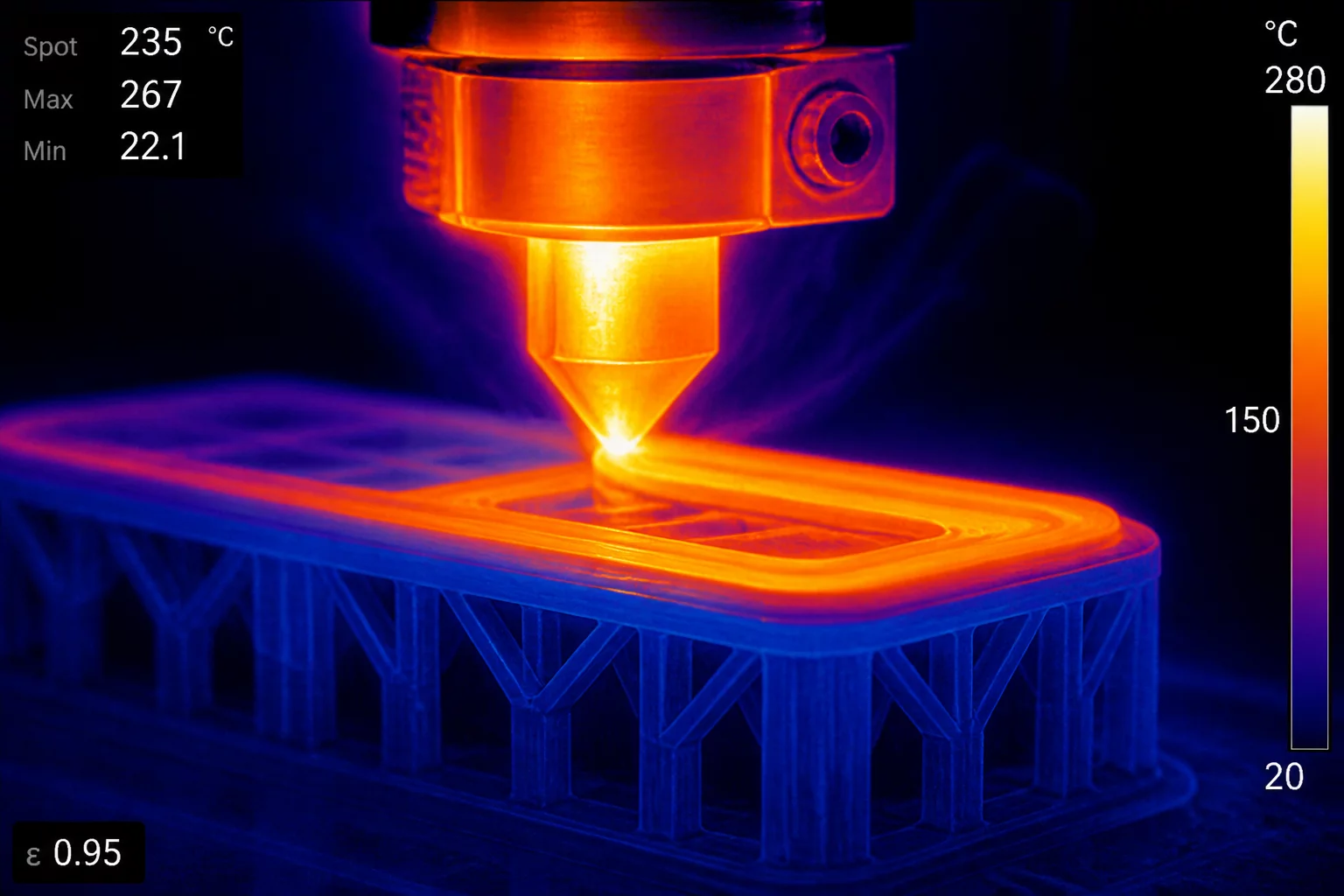
Micro-Thermal Equilibrium at the Print Boundary
When a molten polymer strand emerges from the nozzle at temperatures exceeding two hundred degrees Celsius, it deposits directly over a previously cooled support roof. Heat from the fresh extrusion conducts rapidly downward into the interface ribs. If the support substrate remains near its glass transition point, the polymer chains across the contact plane interdiffuse, forging unwanted permanent polymer welds that destroy surface finish upon manual detachment.
Convective cooling from dedicated part-cooling fans establishes a sharp temperature gradient across this micro-gap. High velocity airflow strips away residual thermal energy before polymer chain entanglement crosses the critical crystallization threshold. Precise cooling prevents deep polymer fusion while preserving enough surface tension to sustain flat horizontal overhang bridges.
Cooling Curves and Glass Transition Thresholds
Thermal imaging reveals distinct cooling trajectories between dense interface patterns and open rectilinear scaffold towers. Dense roofs act as localized heat sinks that retain elevated temperatures longer than thin pillars. Managing this localized thermal reservoir requires synchronizing fan speed curves directly with interface layer exposure timers.
- A 15°C reduction in interface extrusion temperature reduces peel force requirement by 38% without causing bridge sagging.
- Targeted 100% fan speed engagement on overhang bridges solidifies the underside before thermal conduction softens interface ribs.
- Differential contraction rates between rapidly quenched bridges and slowly cooled interface grids trigger micro-fissures that facilitate clean mechanical release.
Practical Slicer Tuning for Interface Heat Management
Balancing thermal dynamics requires tuning bridge flow ratios and contact layer speed overrides within modern slicing engines. Slowing down the first model layer above supports allows the print cooling fan to build a strong thermal buffer, ensuring that the molten filament cools to its solid state before forming adhesive bonds with the underlying grid.
Adjusting the vertical air gap to match the thermal expansion coefficient of the selected filament ensures predictable part accuracy. Slicers calculating localized thermal dissipation deliver crisp overhang contours while eliminating tedious post-processing labor and contact scarring.
Discussion & Peer Findings
0 RemarksNo observations recorded yet. Be the first to submit thermal data or peel force findings.
Leave Laboratory Observation