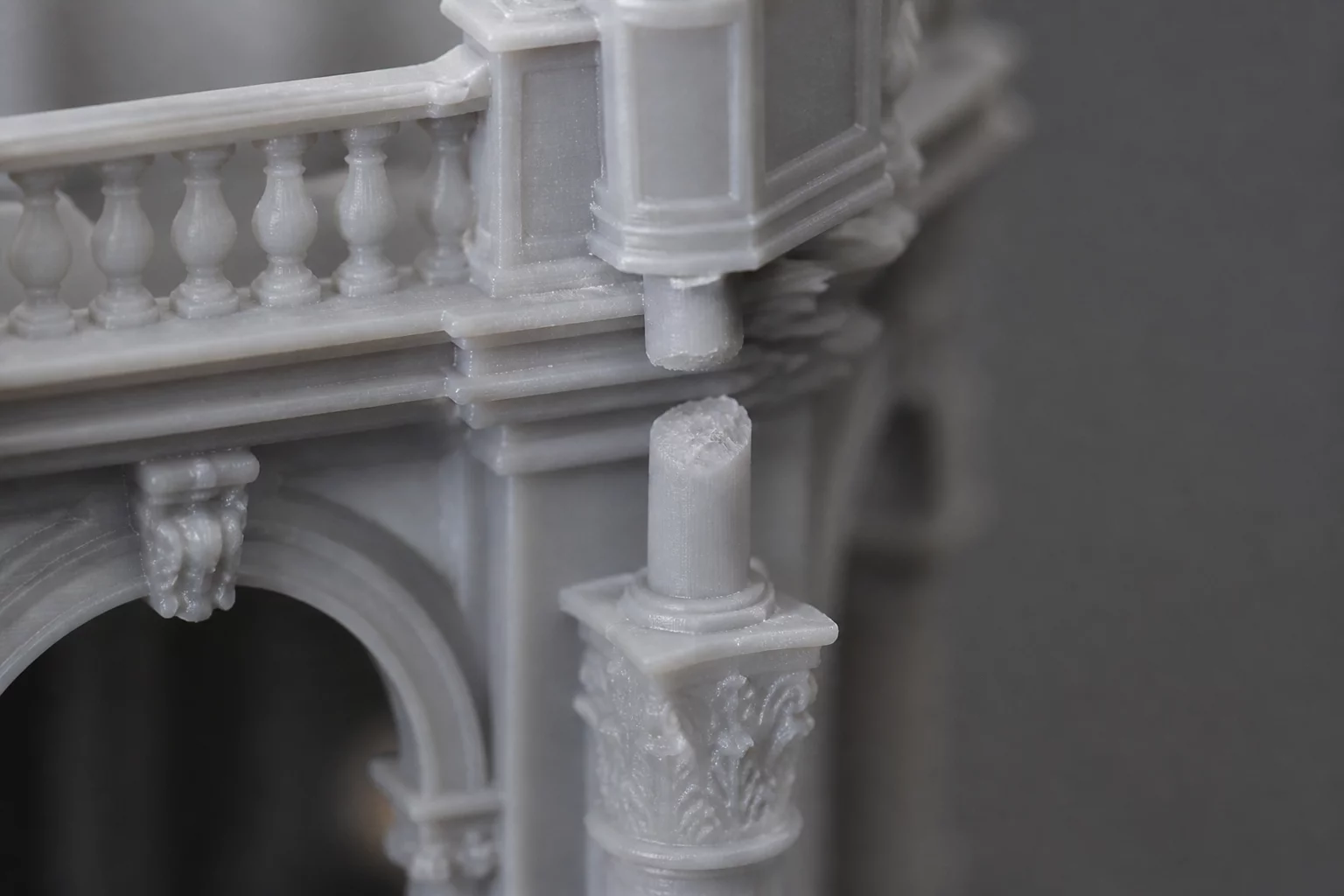
Anatomy of the Delicate Overhang Failure
A standard mechanical chassis with a fragile 1.2 mm locking snap-arm was sliced using universal linear support parameters. While the bulk underside of the enclosure printed cleanly, the mechanical snap-arm snapped off cleanly during support removal. The uniform support structure bonded so tightly across the tiny contact area that the shear force required to break the interface exceeded the yield strength of the miniature feature itself.
Global slicer presets often treat every downward face equally, applying identical interface density, expansion margins, and vertical offsets. In complex components where massive planar overhangs coexist alongside fragile decorative or mechanical protrusions, a single global support recipe almost always sacrifices the weakest feature. Understanding 3D print support problems requires isolating these delicate zones from the macro geometry.
Diagnostic Evaluation and Support Surface Quality
Physical measurement with a mechanical force gauge revealed that standard grid supports exerted 4.6 N of tensile resistance across the snap-arm tab. By shifting that specific sub-region to a custom per-model support blocker and enforcer strategy in UltiMaker Cura, the outcome changed dramatically:
- Local Z-distance was increased from 0.16 mm to 0.24 mm exclusively beneath the 1.2 mm snap-hook, allowing it to bridge with negligible fusion.
- Support interface density was reduced from 80% grid to 45% concentric circles, dropping total bonding contact area by more than half.
- Support horizontal expansion was zeroed out locally to prevent the support pillar from wrapping around the thin vertical column of the snap.
Comparative Benchmark and Practical Takeaways
The modified print maintained crisp dimensional tolerances and preserved the snap-arm with zero mechanical degradation during interface release. Examining the support surface quality showed clean layer deposition without droop or stringing, proving that targeted configuration yields superior results compared to blanket parameter increases.
Slicing workflows benefit when operators adopt targeted modifier meshes instead of escalating global support distances, which would otherwise degrade large flat ceilings. In our PrusaSlicer support outcome review and comparative Cura benchmarks, localized control remains the single most reliable strategy for preserving delicate features without sacrificing surrounding bridge fidelity.
Discussion & Peer Findings
0 RemarksLeave Laboratory Observation