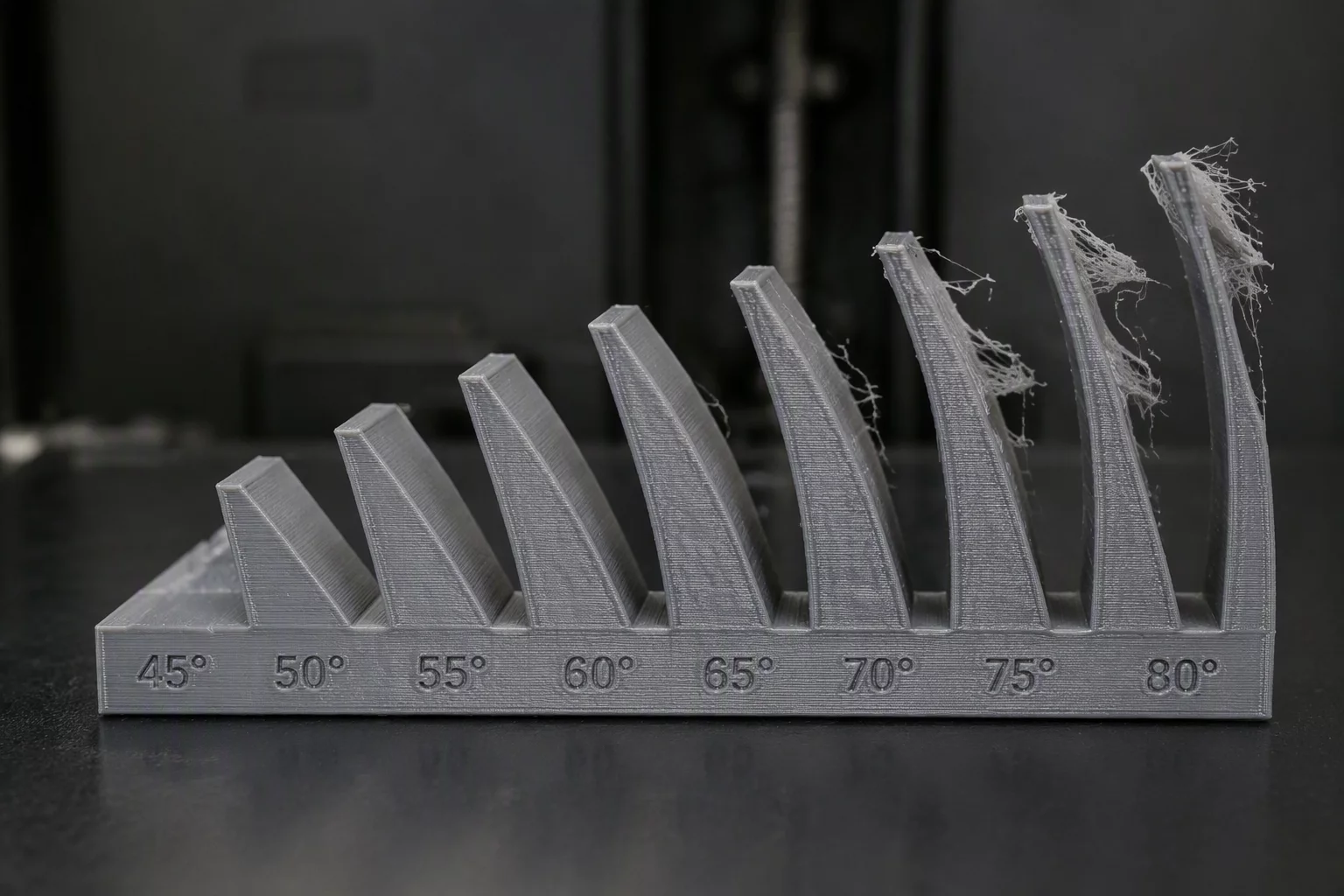
The Diagnosis: A 70° Overhang That Refused to Behave
The part in question was a mounting bracket with a long cantilevered arm extending off the main body at a steep 70-degree angle. In its default orientation, Cura automatically generated a dense forest of tree supports beneath the arm. Despite careful tuning of the Z-distance and interface density, every print run produced visible scarring on the downward face, and the support columns were stubbornly fused to the part's underside, requiring up to eighteen minutes of plier and scraper work per unit.
Multiple iterations of interface pattern, contact spacing, and fan speed adjustments reduced the severity of the scarring but never eliminated it. The fundamental problem was geometric: as long as the arm projected at 70 degrees from vertical, some form of sacrificial scaffolding was unavoidable, and any scaffolding in contact with a cosmetic surface leaves a witness mark.
The Strategic Pivot: Rotating the Part Instead of Tuning the Support
Rather than continuing to fight the support engine, the geometry was re-examined in Cura's build-plate orientation dialog. Tilting the entire part 35 degrees around the Y-axis transformed the 70-degree overhang into a 35-degree surface, comfortably below the 45-degree self-supporting threshold for PETG with a 0.2mm layer height. Cura's support generator immediately reported zero required support structures.
- Original overhang angle: 70° from vertical, requiring dense tree support across 180mm of length.
- After 35° Y-axis rotation: effective overhang dropped to 35°, fully self-supporting.
- Print time fell from 4h 12m to 2h 38m, a 37% reduction, with zero support material consumed.
Outcome and Surface Quality Verification
The reoriented print completed without a single support structure. The previously scarred underside of the arm now printed as a continuous perimeter wall, producing a uniform matte finish with Ra 1.8 µm, indistinguishable from the rest of the part's exterior. Post-processing time dropped from eighteen minutes to under thirty seconds of light deburring at the layer-start z-seam.
This case reinforces a core principle documented throughout our PrusaSlicer support outcome review and Cura archives: the cheapest support is the one you never generate. Before tuning interface density or contact distance, always evaluate whether a simple orientation change can move the problematic geometry below the self-supporting threshold. Reorientation is often faster, cleaner, and cheaper than even the most refined support strategy.
Discussion & Peer Findings
0 RemarksThis could be your first comment. Share your laboratory observation below.
Leave Laboratory Observation