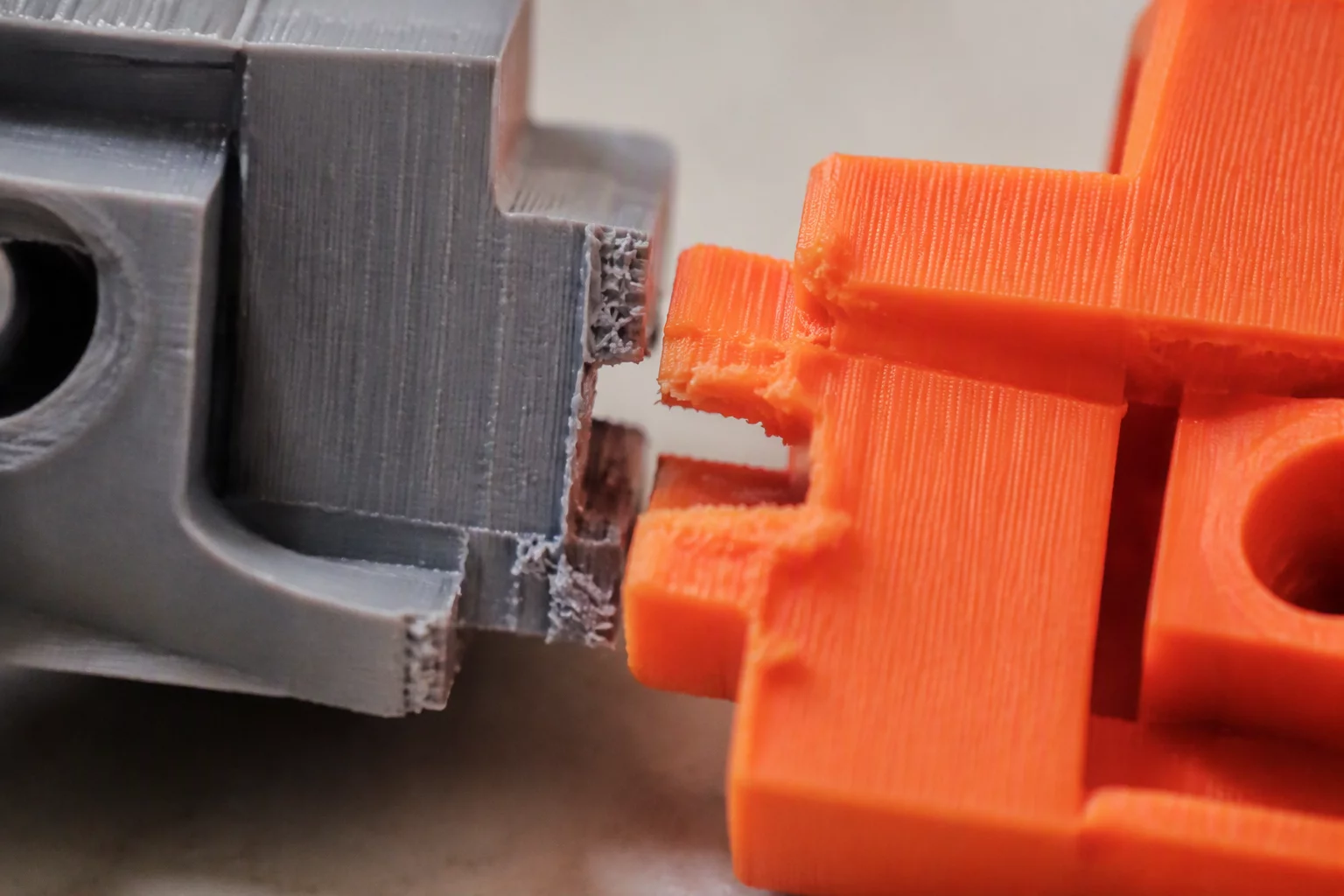
The Trade-Off Between Overhang Geometry and Mechanical Clearance
Resolving extreme overhangs often tempts engineers to maximize support interface density and shrink the vertical separation gap. In this case study, a snap-fit enclosure required a 90-degree internal ledge to hold an electronic PCB carrier securely. Standard tree supports with wide contact distances left drooping filament loops, prompting a switch to dense rectilinear interfaces with a tight 0.12mm Z-distance.
While the bottom bridge printed flawlessly without visible sagging, post-processing revealed severe 3D print support problems when attempting to slide the mating sub-assembly into position. Micro-droplets of fused interface material fused slightly with the perimeter paths, expanding local wall dimensions by nearly 0.28mm. The overhang achieved crisp aesthetic fidelity, yet functional mechanical assembly was completely obstructed.
Dimensional Analysis and Interface Peeling Friction
Examining the mating surface under optical measurement demonstrated that close contact distances under high nozzle temperatures promote thermal micro-welding between support roofs and active extrusion perimeters. In our PrusaSlicer support outcome review and comparative Cura slicing passes, several key factors contributed to this mechanical failure:
- Contact Z-distance below 0.16mm caused partial plastic coalescence on wide horizontal planes, preventing clean boundary detachment.
- Lateral support expansion pushed interface material directly against vertical alignment ribs, shrinking internal clearances from 0.40mm down to 0.12mm.
- Support interface density above 85% significantly hindered manual detachment tools, leaving stubborn microscopic ridges along the sliding rails.
Corrective Slicing Strategy and Tolerance Recovery
To recover accurate support surface quality without sacrificing overhang flatness, we decoupled support roofs from structural alignment walls using custom support blockers. Increasing the Z-distance to 0.20mm while setting a 0.50mm X/Y support clearance preserved critical rail dimensions.
Furthermore, altering print speed across overhang perimeters allowed adequate cooling fan dwell time, mitigating drooping even with moderate interface density. The redesigned part slid effortlessly into the mating chassis, proving that dimensional tolerances for interlocking assemblies must prioritize clearance margins over purely aesthetic underside finishes.
We ran into identical clearance binding on PETG slide rails. Bumping the contact Z-distance from 0.14mm to 0.20mm completely prevented interface fusion while preserving the 90-degree shelf with zero drooping.