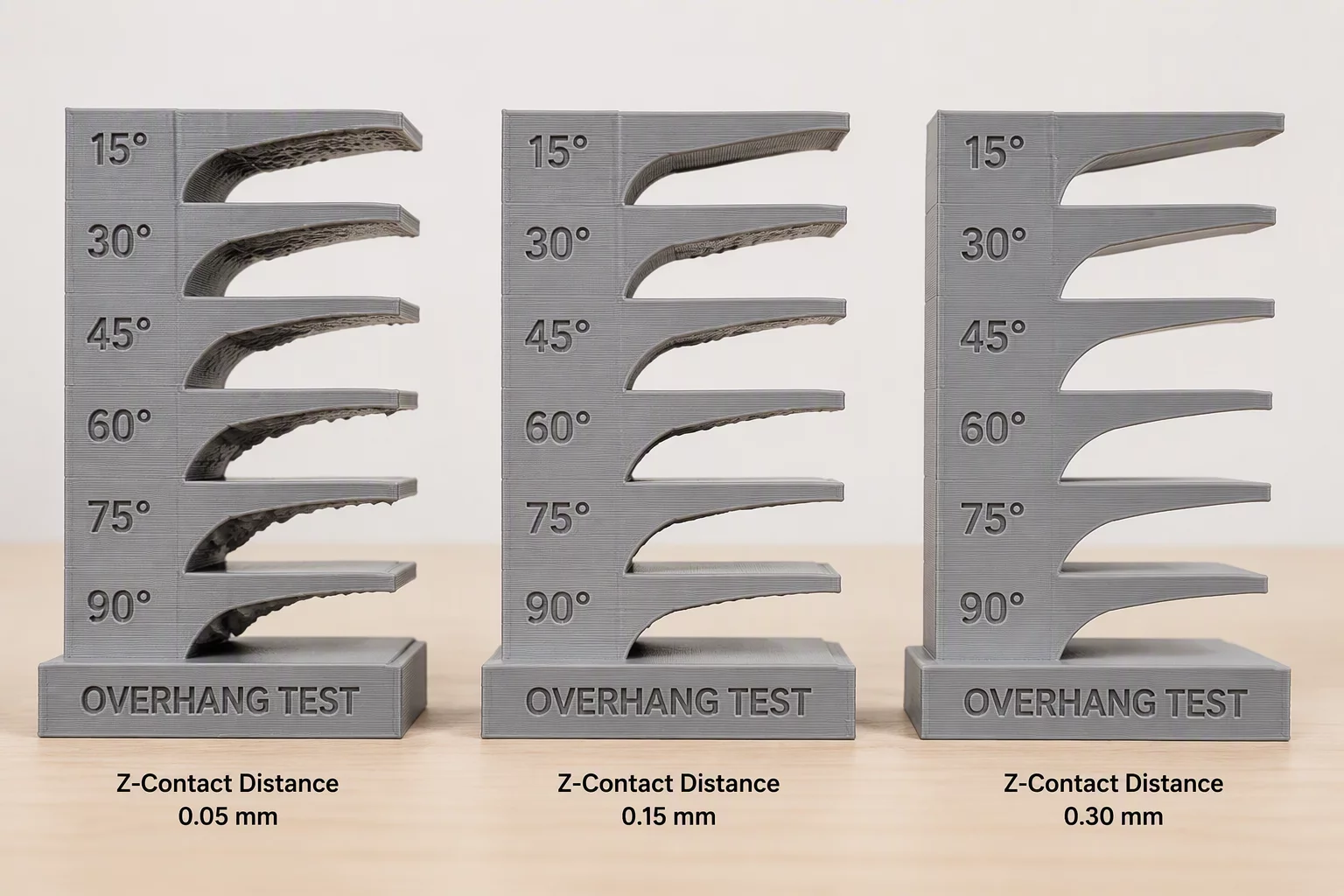
Understanding Support Z-Distance Dynamics
Achieving smooth overhangs while keeping supports easy to peel off requires balancing vertical separation. The contact distance, frequently referred to as top Z-distance or support gap, determines the exact vertical air space left between the top interface layer of the support and the first overhang layer of your model. When this distance is set too tight, molten thermoplastic fuses directly onto the interface lines, leaving stubborn scars that demand tedious scraping or sanding.
Conversely, setting excessive contact distance causes the extruded filament strand to bridge across empty air without adequate structural backing. The unsupported molten thread cools unevenly, resulting in dangling loops, rough stepped textures, and lost dimensional fidelity. Calibration involves identifying the narrow sweet spot where the printed bead rests securely atop the interface without establishing a permanent thermal weld.
Systematic Calibration and Layer Multipliers
Dialing in contact distance depends fundamentally on your chosen layer height, extrusion temperature, and material cooling rate. Most modern slicers calculate vertical separation either as a fixed absolute millimeter value or as a multiple of the current layer thickness. In practice, tying your contact gap directly to layer height steps delivers far more predictable results across varied print profiles:
- For standard 0.20mm layer heights with rigid PLA, a single layer gap of 0.20mm (100% layer height) delivers clean release and minimal sag on flat ceilings.
- Tougher materials like PETG or ABS require a slightly wider clearance of 0.24mm to 0.28mm to compensate for increased polymer stickiness and radiant nozzle heat.
- Increasing part cooling fan speed to 100% during the overhang bridge layer immediately solidifies the extrudate, preventing deep penetration into the support grid.
Combining Interface Density with Horizontal Separation
Vertical contact distance works in conjunction with horizontal X/Y offset and interface density. A dense interface with 80% to 90% pattern density provides a nearly continuous shelf, allowing you to run a slightly larger Z-gap while preserving crisp geometry. When using sparse support patterns directly beneath overhangs, the plastic sinks into open gaps regardless of your Z-distance setting.
Furthermore, keep horizontal support expansion and separation around 0.5mm to 0.8mm to prevent side-wall fusion on vertical contours. By combining a 1-to-1.2x layer height vertical gap with dual dense interface layers and rapid local cooling, post-processing transitions from aggressive scraping into a quick, tool-free snap.
Reduced interface layer gap to 0.16mm on our PETG prints with organic tree supports. The contact scarring dropped significantly and overhangs at 65° remained crisp with zero sagging. Highly recommend testing the custom peel angle settings!