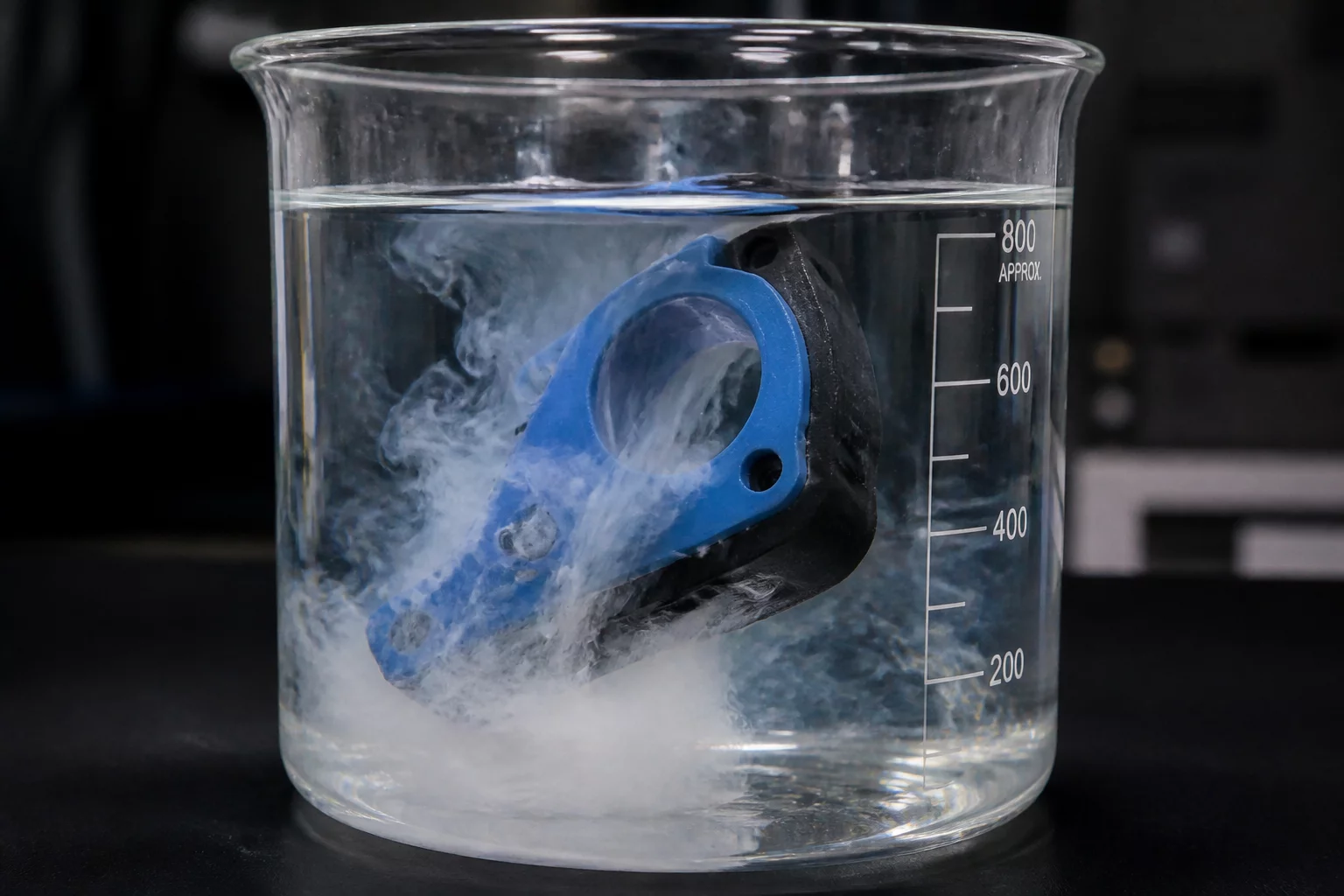
Eliminating Contact Distance with Dissolvable Interfaces
In conventional single-material printing, slicing engines force a vertical air gap between 0.15mm and 0.28mm between the support interface and the model surface. This necessary gap prevents permanent fusion, yet it inevitably compromises overhang fidelity, resulting in drooping bridge lines, loose outer perimeter rings, and rough stair-stepping textures. Water-soluble filaments such as polyvinyl alcohol (PVA) and butenediol vinyl alcohol copolymer (BVOH) render this compromise obsolete.
By routing soluble filament strictly to the dense interface layers while printing the main structural scaffolding out of standard PLA, makers achieve surgical precision without excessive spool waste. Setting the top contact Z-distance to exactly 0.00mm allows the build material to compress firmly against the solid soluble roof, mirroring the exact flat finish normally seen against a glass build plate.
Thermal Purging and Dissolution Acceleration Techniques
Maximizing surface yield with soluble filaments requires meticulous moisture control and active water management. Water-soluble filaments behave hydroscopically, absorbing ambient humidity within hours and causing steam micro-explosions at the nozzle tip. Implement these crucial shop-floor controls to guarantee repeatable success:
- Purge volume calibration: Set transition purge volumes between 280mm³ and 340mm³ when switching from PVA to PLA to avoid brittle boundary layer contamination.
- Heated ultrasonic agitation: Dissolve parts in circulating water warmed to 38°C–42°C with ultrasonic micro-vibrations to reduce wash tank dwell time by up to 65%.
- Hydrophobic chamber storage: Store active PVA spools in active desiccant dry boxes maintaining relative humidity below 15% during multi-day prints.
Preventing Cross-Contamination and Material Creep
A recurring failure mode in multi-material toolheads is heat creep inside the soluble hotend during extended idle standby periods. Lowering the standby temperature by 25°C prevents PVA from baking into a carbonized plug inside the heatbreak while the primary extruder deposits main model layers.
Furthermore, when printing structural PETG alongside water-soluble supports, BVOH provides superior thermal resistance and bonding characteristics compared to standard PVA. Following dissolution, rinse the finished object under running warm demineralized water and dry thoroughly at 45°C in a convection dehydrator to prevent hygroscopic softening of the primary polymer.
Discussion & Peer Findings
0 RemarksNo comments recorded yet. Be the first to share your laboratory observation.
Leave Laboratory Observation