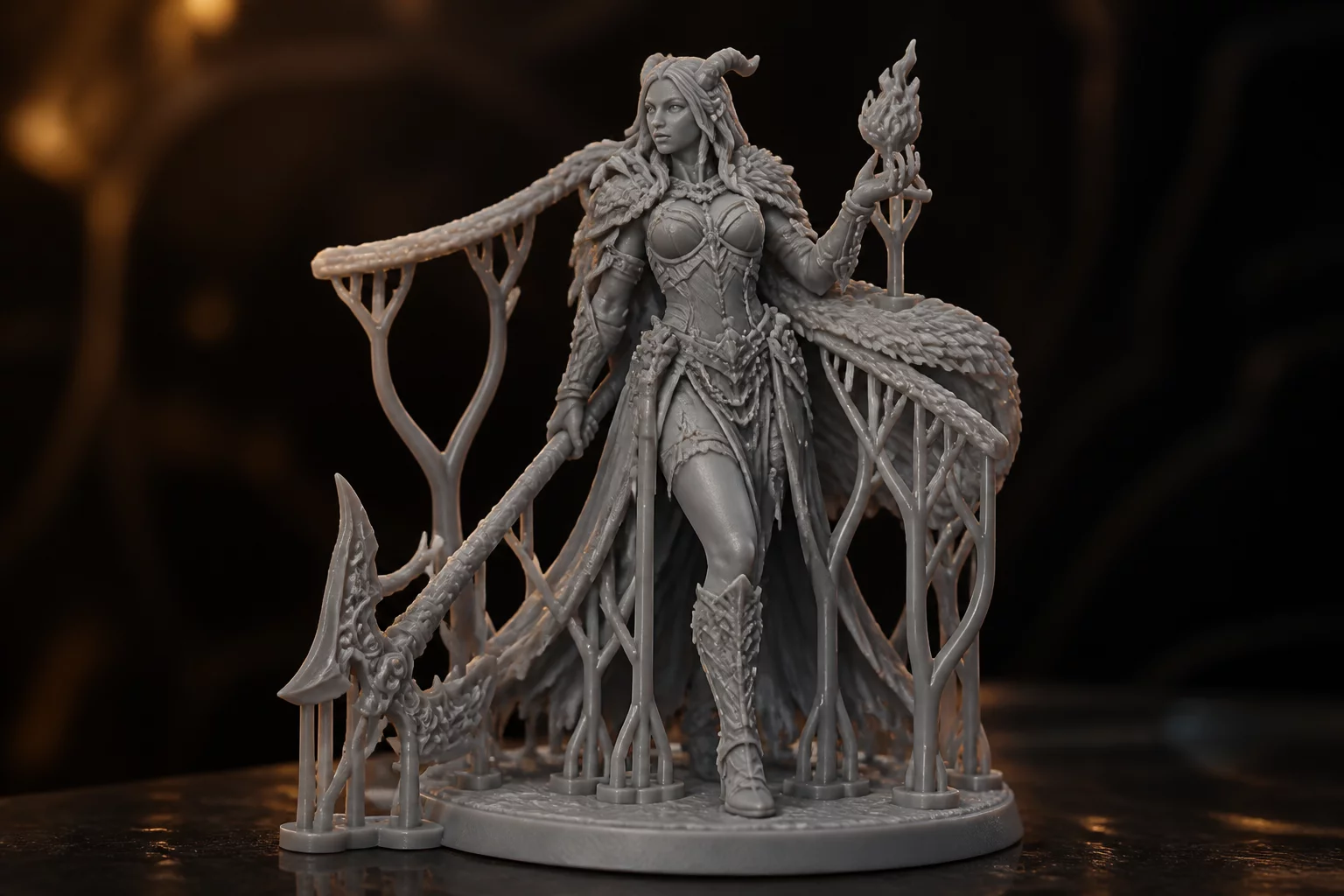
Understanding the Mechanics of Organic Tree Supports
Tree supports operate by growing hollow, branching trunks from the build plate around the perimeter of your model rather than projecting vertically directly below every single overhang. This structural geometry allows the support contact points to reach complex overhangs, chin details, and floating architectural elements without ever anchoring directly onto delicate lower surfaces of the print itself.
Unlike standard linear or grid supports that fill extensive vertical columns from top to bottom, tree supports dynamically split and merge as they climb. Because the contact area is localized to small conical tips, the peeling force required during post-processing drops drastically. The resulting bottom interface preserves layer fidelity without leaving extensive grid scarring across visible cosmetic contours.
Optimal Scenarios for Selecting Tree Supports
Selecting between linear columns and organic tree structures depends heavily on the model's geometry, orientation, and functional requirements. Tree supports show decisive mechanical and cosmetic advantages in several distinct printing configurations:
- Organic Sculptures and Miniatures: Intricate organic shapes with overhangs located above finished details benefit most because branches wrap around lower geometries without touching them.
- Material and Filament Conservation: Tall prints with isolated high overhangs require up to 60% less support material compared to full-height rectangular support blocks.
- Delicate Fine Features: Thin appendages and fine details snap easily during linear support breakaway, whereas narrow tree tips snap off cleanly under minimal shear stress.
When Linear Grid Supports Remain the Superior Choice
Despite their versatility, tree supports are not universally optimal. Large flat horizontal bridges and wide structural overhangs demand continuous planar support to avoid drooping between branch nodes. In mechanical assemblies with strict dimensional planar tolerances, traditional linear or zig-zag supports with dense interface layers yield flatter, more uniform baseline planes.
Additionally, flexible filaments like TPU or high-speed printing profiles with aggressive acceleration can cause tall slender tree branches to sway or resonate during nozzle travel. For tall, high-mass prints, ensure adequate branch diameter and base adhesion settings in your slicer to prevent support failure mid-print.
Reduced interface layer gap to 0.16mm on our PETG prints with organic tree supports. The contact scarring dropped significantly and overhangs at 65° remained crisp with zero sagging. Highly recommend testing the custom peel angle settings!